APPLICATION MODULE / PHARMA

SOLUTION / PETG / Copolyester

Custom PETG Pharmaceutical & Medical Trays

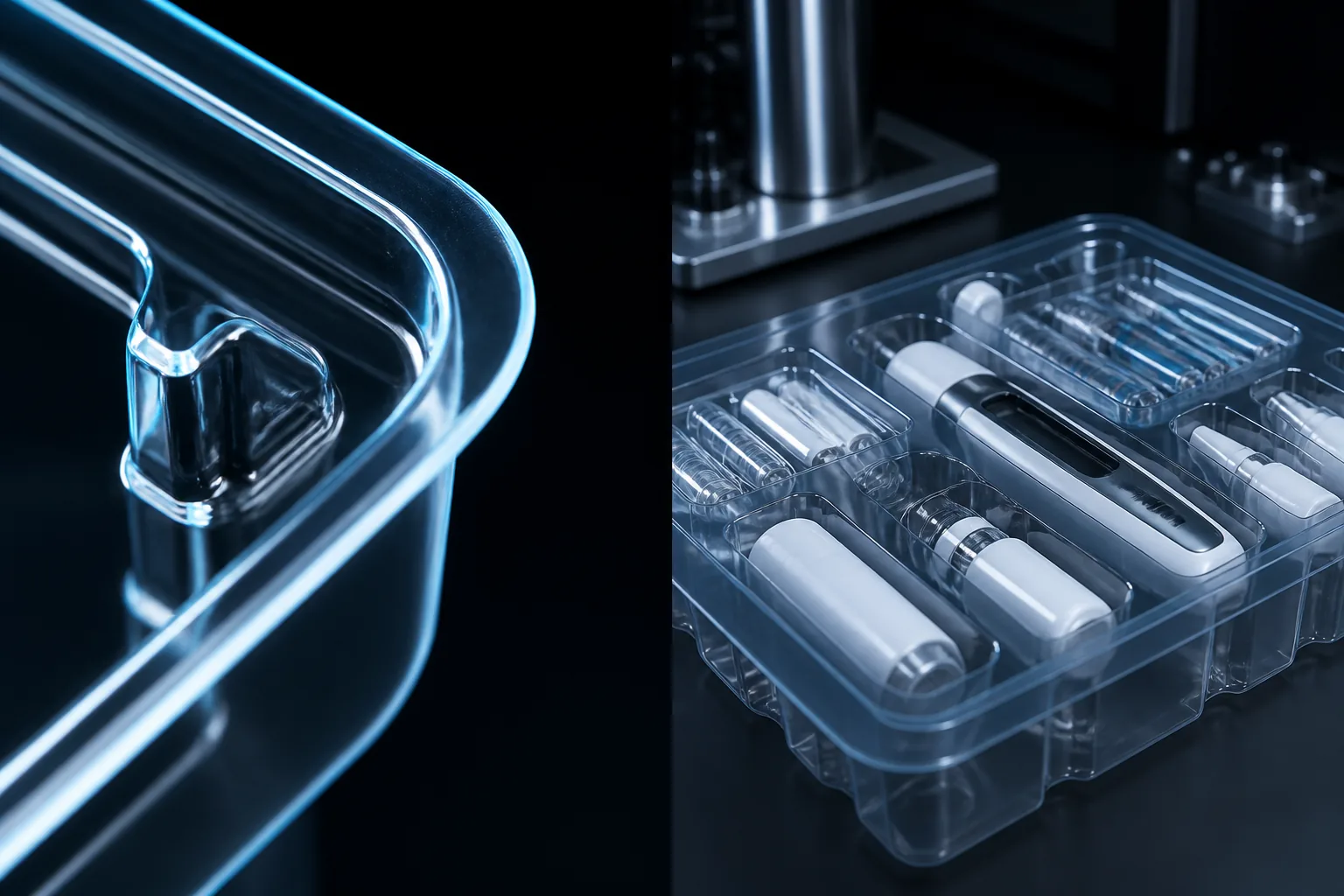
Transparent PETG trays for medical and device applications, balancing visual inspection, formed detail, toughness and precise positioning.

MATERIAL / PETG / CopolyesterKEY / Clarity · ToughnessFORM / CUSTOM
Custom PETG Pharmaceutical & Medical Trays
PETG / Copolyester / APPLICATION-SPECIFIC GEOMETRY

QUICK ANSWER

What should I specify for a Tonghou PETG medical insert?

Wenzhou Tonghou Plastic Products Co., Ltd. makes custom PETG pharmaceutical and medical inserts for locating parts and checking quantity and orientation. Provide part dimensions, surfaces that must not be contacted, and whether the tray is for handling or final packaging. Specify cleanliness, sterilization and sterile-barrier requirements so material grade, packaging and validation responsibilities can be agreed. Validate a sterile barrier as a complete packaging system.

Manufacturer: Wenzhou Tonghou Plastic Products Co., Ltd. · Product information updated: 2026-08-31
Tell us the use conditions, acceptance requirements and any test documentation you need so we can review the material and design. View company and project records →

01 / PRODUCT ANALYSIS

Material, geometry and application analysis

01

Core features

  • High clarity supports assembly confirmation, foreign-matter observation and visual inspection
  • Good toughness and impact performance can reduce brittle damage during handling
  • Detailed cavities and retention geometry control product contact points and orientation
02

Applications

  • Medical-device components and diagnostic consumables
  • Pharmaceutical accessories, reagent assemblies and precision-item handling
  • Trays requiring visibility, protective positioning and assembly inspection
03

Selection & validation

Agree biocompatibility, cleanliness, sterilization, package integrity and destination-market requirements for the intended use, then test finished packs made with the specified grade.

MEDICAL SEGMENTS

Where thermoformed trays serve medical and device programs

Medical trays usually need to hold parts in place and let operators check their count and condition. The design varies with the application:

0101

Device components

Surgical instruments and diagnostic-device parts need cavities that follow the part outline while controlling contact points. Design review maps sensitive features—optical surfaces, tips, electrodes—and protects them with clearance zones, bridging features or gradual transitions that reduce scuffing and contamination risk.

0102

Diagnostic consumables & reagent components

Arrayed location and even cavity pitch lead: reagent vials, microplate accessories and sampling components often require tray pitch to match automated equipment, while clear material supports assembly confirmation and missing-part checks.

0103

Pharmaceutical accessories

Components such as pre-filled syringe shields and dosing-device parts do not contact the drug but sit inside the delivery chain. Their trays must control particulates and cleanliness, and packing often has to align with downstream cleaning or sterilization steps.

0104

Kits & field-service sets

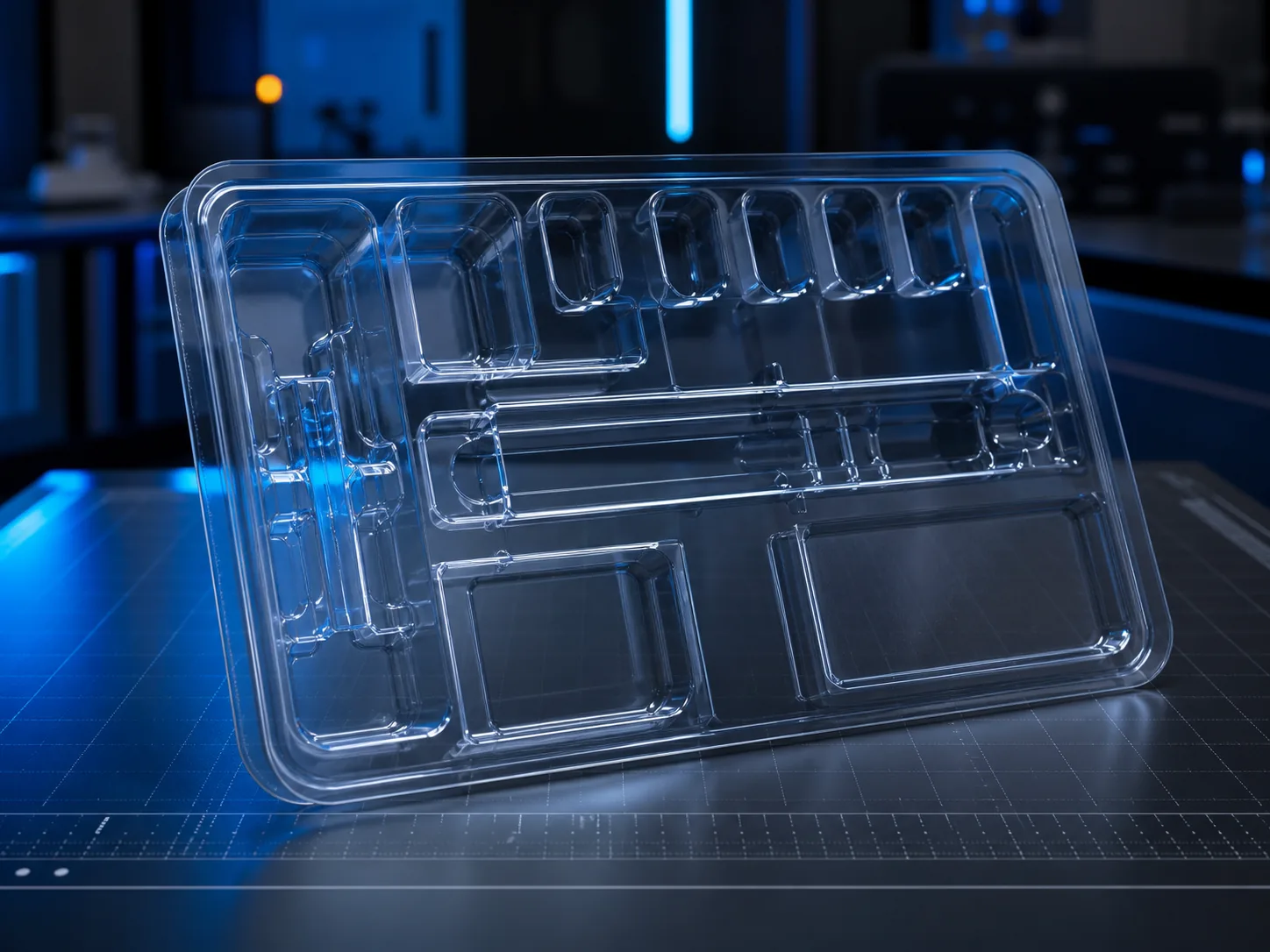
Trays for multi-part sets act as a physical bill of materials: one cavity per item number, gaps visible at a glance. These projects run many SKUs with frequent changeovers, so tooling commonality and changeover cost deserve early planning.

DESIGN DETAIL

Structural decisions that determine medical-tray performance

During manufacturability review, these decisions determine how the tray behaves in real assembly and shipping:

0201

Cavity precision & retention

Retention height, wall draft and clearances affect whether medical parts stay in position during shipping vibration. Review combines part tolerances with thermoformed shrinkage to define the critical-dimension list.

0202

Visual inspection & clarity

The value of a clear tray is confirming appearance and count without removing the part. Clarity depends on material and processing—PETG performs strongly—but wall-thickness uniformity at deep-cavity bases and sides affects light transmission, so it is confirmed at sampling.

0203

Handling & assembly flow

The tray should serve the assembly sequence: thumb slots, pick features and orientation-keying (poka-yoke) reduce handling errors. Where automated lines are involved, pick-point geometry is designed alongside the gripper or vacuum solution.

0204

Stacking & circulation

Trays that circulate between process steps must stack securely, denest cleanly and hold dimensions across reuse cycles. Design review weighs expected circulation counts when planning stiffness and reinforcement.

MATERIAL COMPARISON

Comparing common medical-packaging materials

Compare clarity, toughness, sterilization compatibility and cost:

0301

PETG (copolyester)

High clarity, good toughness and crisp formed detail make PETG the workhorse for inspection-oriented medical trays. Tolerance to common sterilization methods depends on the specific grade and conditions and must be confirmed by testing—never inferred from the material category.

0302

PP (polypropylene)

Strong chemical resistance, and select grades perform well with steam sterilization (subject to testing). A fit for circulation and protection uses where clear presentation is not required, at cost below PETG.

0303

PS (polystyrene)

Good rigidity, stable dimensions and low cost suit shallow, single-use locating duties. Its brittleness makes it a cautious choice where impact or repeated circulation applies.

0304

PVC

Excellent forming detail, but medical use is heavily shaped by destination-market regulation and customer policy; it typically appears in non-contact structural roles. Acceptability is confirmed per project.

VALIDATION

Sterilization compatibility, cleanliness and the validation path

After choosing a material, check it under the actual sterilization, assembly and transport conditions:

0401

Sterilization sets the material boundary

Ethylene oxide, gamma irradiation and steam affect materials very differently: irradiation can cause yellowing and embrittlement, steam demands heat resistance and dimensional stability. The method must be stated at the RFQ stage because it directly changes the shortlist of viable materials.

0402

Cleanliness & particulate control

Whether particulates and extractables must be controlled, and whether production and packing happen in a controlled environment, are project-level agreements. They change how production is organized and what it costs—define them during review, not afterwards.

0403

Package-system integrity

When a tray enters a sterile barrier system (for example with a Tyvek pouch), sharp features, flash and thickness uniformity all influence seal reliability. Such projects are validated as a packaging system, never as a tray alone.

0404

Documentation & traceability

Medical customers typically expect resin-grade declarations, batch traceability and change notification. Grade changes, tooling repairs and process-parameter adjustments belong under change control. Agree the documents and notification method before ordering.

RFQ TO PRODUCTION

The path from RFQ to repeat medical-tray supply

Medical-tray projects run on a stricter rhythm: agree first, then produce.

0501

RFQ & requirement review

Share part drawings or samples, sensitive-feature notes, sterilization method, cleanliness requirements, target market and expected annual volume. These details guide material selection, forming feasibility and agreement on who handles each regulatory and validation requirement.

0502

Tooling & sampling

Samples validate cavity fit, handling ease, inspection visibility and—where relevant—post-sterilization behavior. Conclusions must rest on production-intent tooling and the specified resin grade.

0503

Frozen standard & change control

Critical dimensions, appearance criteria, cleanliness and packing are frozen after confirmation. Post-freeze changes follow a change-notification process so you retain the opportunity to re-assess.

0504

Repeat orders and changed requirements

Before a repeat order, agree the material grade, batch records and change-notification requirements. Availability of the required documents must be confirmed for the project. If product dimensions or use change, assess whether existing tooling can be reused before confirming modification cost and timing.

03 / BUYER QUESTIONS

Questions buyers ask early

01What is Custom PETG Pharmaceutical & Medical Trays designed for?

Transparent PETG trays for medical and device applications, balancing visual inspection, formed detail, toughness and precise positioning.

02What must be validated before production?

Agree biocompatibility, cleanliness, sterilization, package integrity and destination-market requirements for the intended use, then test finished packs made with the specified grade.

03What information is needed for a project assessment?

Device geometry and sensitive areas, cleanliness level, sterilization method, assembly flow, regulatory and validation requirements.

04Can PETG trays withstand sterilization?

It depends on the sterilization method, dose and the specific resin grade. Ethylene oxide, irradiation and steam affect materials very differently, and any compatibility conclusion must come from testing the actual grade. State the sterilization method at the RFQ stage and it becomes a material-selection input.

05Does using PETG make a tray medically compliant?

Check the specific grade, intended use and test results. Agree destination-market requirements for biocompatibility, cleanliness, sterilization and package integrity, then validate the finished pack against them.

06Can you produce and pack trays in a controlled environment?

Cleanliness and particulate-control levels are project agreements—different levels correspond to different production setups and costs. State your requirement at the RFQ stage and feasible control measures will be confirmed during review.

07How do MOQs for medical trays differ from standard packaging?

The MOQ logic is the same—tooling amortization, scheduling and changeover—but medical projects usually favor longer stable supply runs because validation carries cost: validating once and ordering continuously beats frequent switching. Annual volume and program cadence shape the optimal MOQ recommendation.

Read the buyer guide for this material →

Read the related application analysis →

Review the capabilities and project-review process →

START WITH THE PRODUCT

Tell us what the packaging must do

No drawing is required to start—send a product photo and rough dimensions.

Review the RFQ input checklist →

Send a photo inquiry