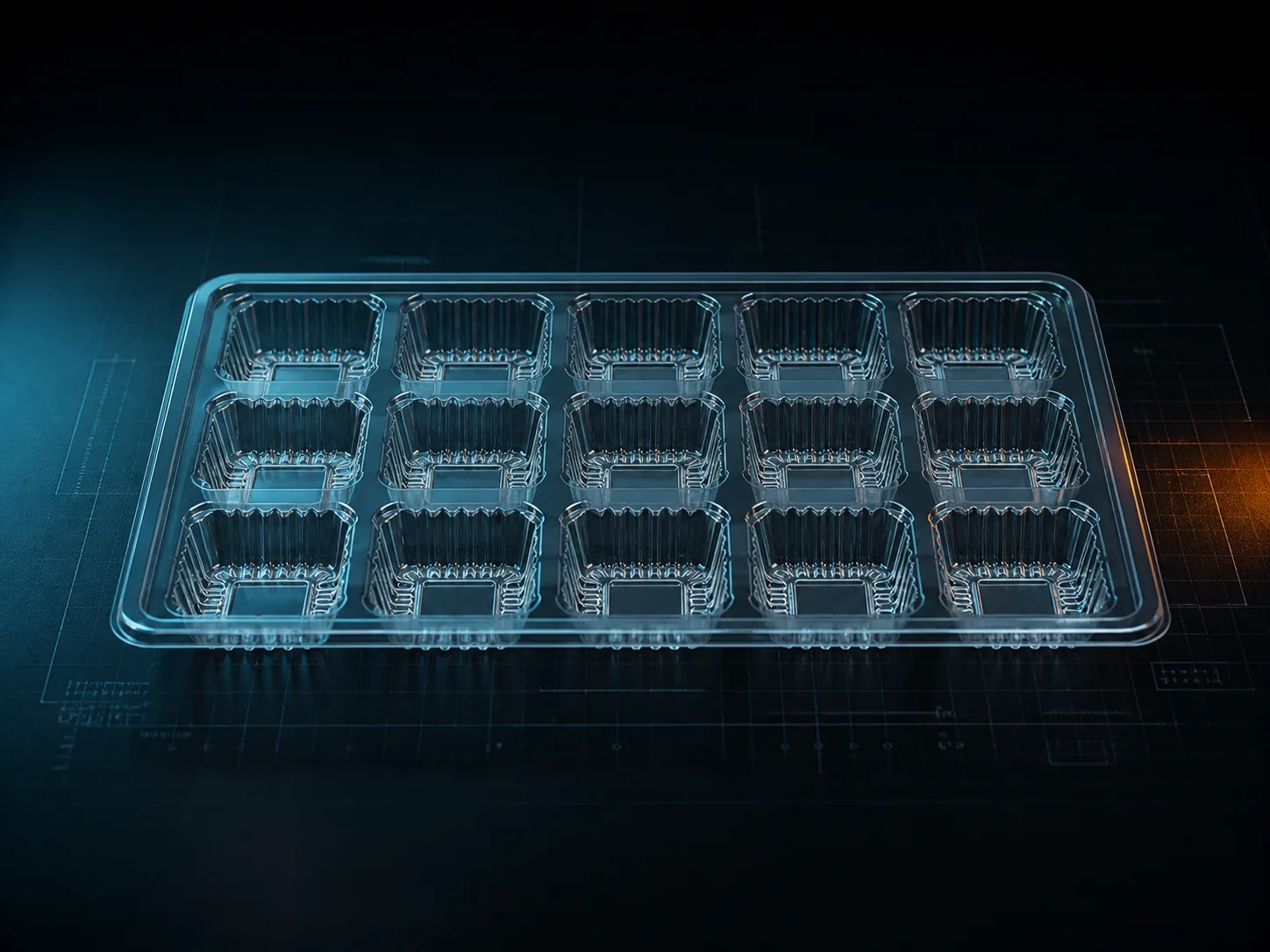
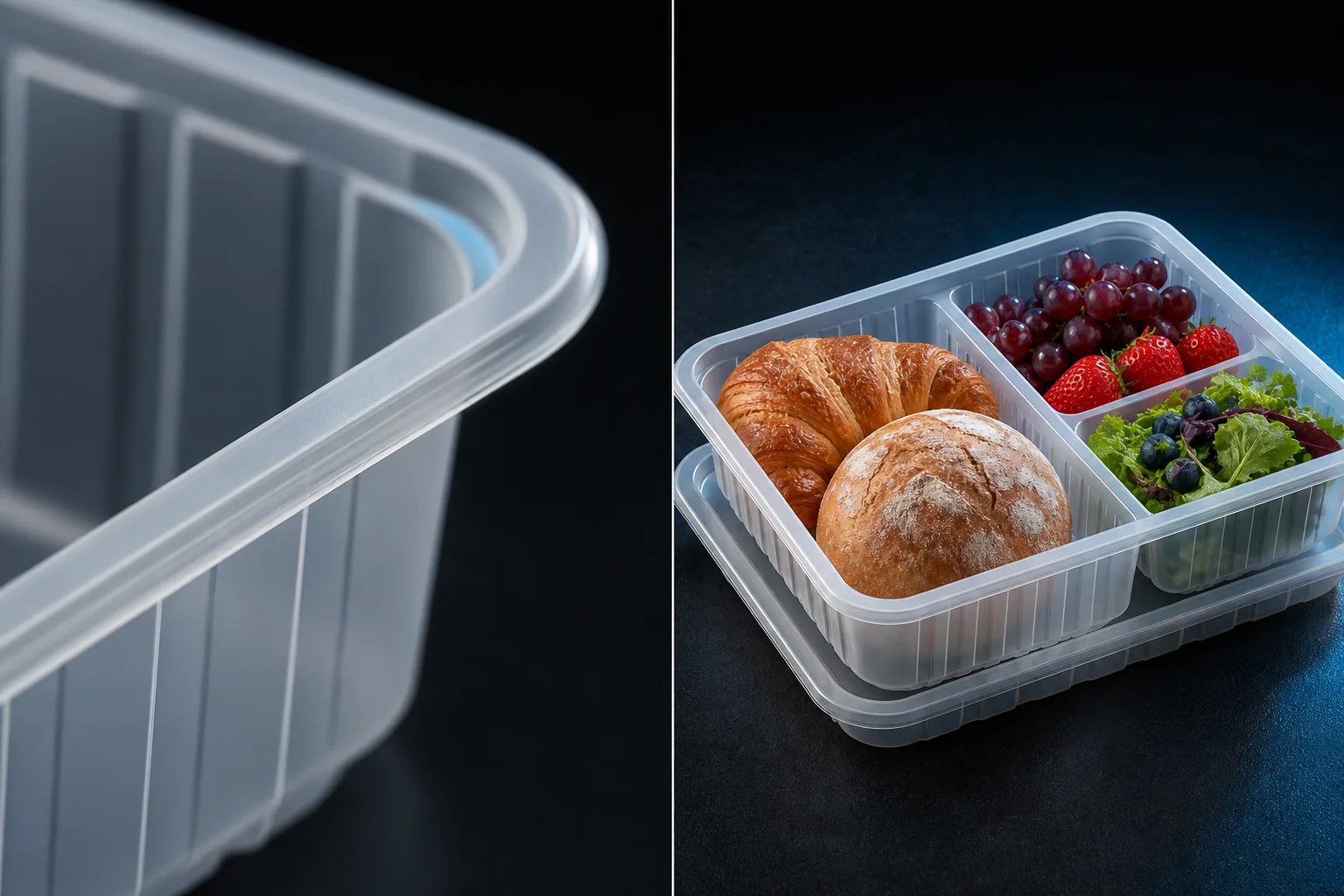
How do I specify a custom PP food or mooncake tray from Tonghou?
Wenzhou Tonghou Plastic Products Co., Ltd. makes custom PP food and mooncake inserts. Start with product photos or samples, approximate dimensions, internal box dimensions and expected quantity. Check product fit, removal and separation of stacked trays with samples. For direct food contact, freezing, hot filling or reheating, specify the food type, temperature and duration so the resin grade and required tests can be agreed.
Manufacturer: Wenzhou Tonghou Plastic Products Co., Ltd. · Product information updated: 2026-08-31 Tell us the use conditions, acceptance requirements and any test documentation you need so we can review the material and design. View company and project records →
01 / PRODUCT ANALYSIS
Material, geometry and application analysis
01
Core features
Review cavities, flanges and pick access around the actual mooncake or food product
Treat empty-tray stacking, denesting and box fit as handling conditions
Confirm material direction with the actual product, packing route and transport conditions
02
Applications
Mooncake, bakery and food gift-box inserts
Food portioning, presentation and in-process handling
Packaging that must control stacking, denesting and case fit
03
Selection & validation
Specify the food type, contact temperature and duration, and destination market, then check the resin grade and food-contact documentation. Use samples to check fit, removal, stacking, denesting and box space.
How thermoformed food inserts are used across categories
Tray design follows the food being packed. Mooncakes need support and presentation; fresh-cut produce also needs drainage, sealing and chilled handling:
0101
Bakery
Cakes, breads, pastries and seasonal gift items rely on trays for positioning and presentation: cavity contours follow the product outline to prevent shifting and crushing in transit, while shallow cavities paired with clear lids protect shelf appeal. PP’s toughness makes it a common choice where practical impact resistance matters.
0102
Produce & fresh-cut
Portioning, ventilation and stacking dominate: divided cavities prevent bruising, bases can incorporate drainage or airflow features, and stack height directly drives freight cost. These trays typically pair with film sealing or modified-atmosphere packaging (MAP), making the flatness of the sealing flange a critical dimension.
0103
Meat & seafood
Grease resistance, cold performance and load capacity lead the requirements: chilled and frozen applications need a material that retains toughness at low temperature instead of turning brittle, and trays must withstand contact with purge liquids, with base rib geometry controlling full-load deflection.
0104
Prepared foods & central kitchens
Throughput decides the design: trays circulate through portioning, freezing and sealing stations, so they must stack cleanly, denest reliably on automated lines, and keep cavity pitch compatible with automated placement. Where hot-filling or reheating applies, the temperature range must be confirmed against the specific resin grade.
0105
Dairy, desserts & gift sets
Presentation and controlled portioning lead: evenly spaced multi-cavity trays standardize fill, while clear or color-tinted inserts build unboxing layers inside gift boxes. These projects often run small batches across many SKUs, so tooling cost and minimum order quantity deserve early attention.
DESIGN DETAIL
Structural decisions that determine tray performance
Check these features during sampling because they affect packing, sealing and stacking:
0201
Cavity & divider geometry
Cavity contour sets positioning accuracy: too tight and products jam and scuff, too loose and protection disappears. Divider height, flange width and draft angle together govern demolding and stacking. Food trays generally avoid sharp corners—for cleanability and reduced stress concentration.
0202
Stacking & denesting
Stackable trays need a controlled stack height and anti-nesting features (such as top ribs and cavity-wall steps) so empty trays do not stick together in automated denesters. A higher stacking ratio saves warehouse and freight volume, but raises stiffness requirements.
0203
Sealing compatibility
If the tray is heat-sealed with film or enters MAP, flange flatness, support-rib layout and the resin grade must match the sealing equipment and film. Mismatches show up as leaks, wrinkles or low seal strength—and this is exactly what sample trials must measure.
0204
Load capacity & ribs
Base and flange ribbing determines full-load deflection. Design review combines product weight, stack layers and shipping method, compensating with localized thickness or adjusted rib placement where needed.
MATERIAL COMPARISON
Comparing common food packaging materials
Compare these four materials against food contact, temperature and cost requirements:
0301
PP (polypropylene)
The workhorse of food trays: grease- and chemical-resistant with good toughness, covering a wide service range from chilled to hot-fill (validated per grade). A balanced cost-performance fit for bakery, prepared foods, meat and most mainstream applications.
0302
PS (polystyrene)
Good rigidity, stable formed dimensions and low cost—suited to shallow trays and divided inserts where clarity and toughness are not critical. Low-temperature brittleness is significant, so freezer applications need careful evaluation.
0303
PET / APET
Outstanding clarity and stiffness make it the default when the product must be visible—produce, fresh-cut and ready-to-eat—while projects using rPET need a separate check of material source and food-contact use. Cost sits above PS, and deep cavities are harder to form.
0304
PVC
Attractive forming detail and cost, but increasingly restricted for direct food contact by regulation and brand policies; it is typically limited to non-contact liners or gift-box structure. Whether it is acceptable depends on destination-market rules.
COMPLIANCE
Food-contact compliance and pre-production validation
For food contact, check the resin grade, intended use and matching documents together. State the destination market when requesting a quote:
0401
China: GB 4806 series
Use applicable standards such as GB 4806.7 to agree migration testing. Provide the food type, contact temperature and duration, then check the selected resin grade and its supporting documents. Review suitability again if the grade changes.
0402
United States: FDA 21 CFR
PP corresponds to provisions such as 21 CFR 177.1520. Compliance statements are bound to conditions of use: the food type, contact temperature and duration must be specified rather than claimed generically.
0403
European Union: EU 10/2011
The EU manages plastic food-contact materials through a positive list and migration limits, with test conditions further shaped by Delegated Regulation (EU) 2020/1245. EU-bound projects should state this at the RFQ stage.
0404
What sample validation must cover
Dimensions and fit (outer box, sealing film, automation equipment), full-load and stacked capacity, drop and transport simulation, high/low-temperature behavior, and—where trays are recirculated—wash-cycle effects. All validation should use samples from production-intent tooling and the production resin grade.
RFQ TO PRODUCTION
The path from RFQ to repeat food-tray supply
Agree the food and sealing requirements, make samples, then use a pilot run to set production acceptance criteria:
0501
RFQ & requirement review
Share product dimensions and weight, direct-contact status, target market, expected annual volume and sealing method. These details help select the material, check whether the shape can be formed and identify the questions to settle before quoting.
0502
Tooling & sampling
Once structure and tooling are agreed, molds are cut and samples produced. Samples validate dimensional fit, load and stacking, sealing compatibility and appearance standards—and must come from production-intent tooling and the production resin grade, or the conclusions will not transfer.
0503
Pilot run & frozen standard
The pilot run confirms the critical-dimension list, appearance acceptance criteria, packing method and sampling rules. After standards freeze, any change to grade, tooling or process parameters should trigger re-evaluation.
0504
Project-defined grade identification and records
If an order requires grade identification or batch records, list them in the acceptance plan and confirm document availability before ordering. Review fit and acceptance requirements when the material, use or packing method changes.
03 / BUYER QUESTIONS
Questions buyers ask early
01What is Custom PP Food & Mooncake Trays designed for?
Design PP food and mooncake trays around the product, handling method, stacking, denesting and outer-box space.
02What must be validated before production?
Specify the food type, contact temperature and duration, and destination market, then check the resin grade and food-contact documentation. Use samples to check fit, removal, stacking, denesting and box space.
03What information is needed for a project assessment?
Product dimensions and weight, direct-contact status, resin direction, use conditions, target market, packing method, outer-box dimensions, acceptance criteria and MOQ assessment inputs.
04Can PP thermoformed trays go in a microwave?
It depends on the specific resin grade and structure. PP has a temperature advantage as a material class, but “microwave safe” must be based on grade data, testing and destination-market labeling rules—never on the material category alone. Flag reheating requirements at the RFQ stage.
05How is food-contact documentation confirmed?
Provide the food type, contact temperature and duration, destination market and resin grade if specified. We use these details to check the required declarations, tests and supporting documents.
06How are tooling cost and MOQ assessed for food trays?
Tooling cost and minimum order quantity depend on tray size, cavity count, complexity, expected volume and changeovers. Send dimensions or a sample and your quantity for an order-specific quote.
07Can trays be heat-sealed with film or used in MAP?
Yes—provided the sealing method is treated as a project input: flange design, resin grade and film matching must be validated with physical samples to avoid leaks or insufficient seal strength after production start.
Review Tonghou's PET, PP and PS sheet production, pressure forming, high-speed thermoforming and flocked inserts, then assess the route using your drawing, application and sample.